

 By Redmayne Smith Marketing LLC
Two Investors, One Question
Imagine two investors sitting down with the same budget, the same goals, and completely different instincts.
Sarah has followed Manchester for years. She has watched the Northern Quarter go from warehouses to wine bars, and she is convinced the city's momentum still has room to run. Tom, on the other side, keeps hearing about Birmingham. HS2's Curzon Street terminus is rising a few miles from where he grew up, and he can't shake the feeling he is looking at "the next Manchester" before everyone else notices.
Both have their reasons to be interested. Manchester and Birmingham are consistently ranked among the UK's top property investment cities, but they reward different strategies and they are not interchangeable. Here's how they actually compare, and how to work out which one fits your investment goals.
The Headline Numbers
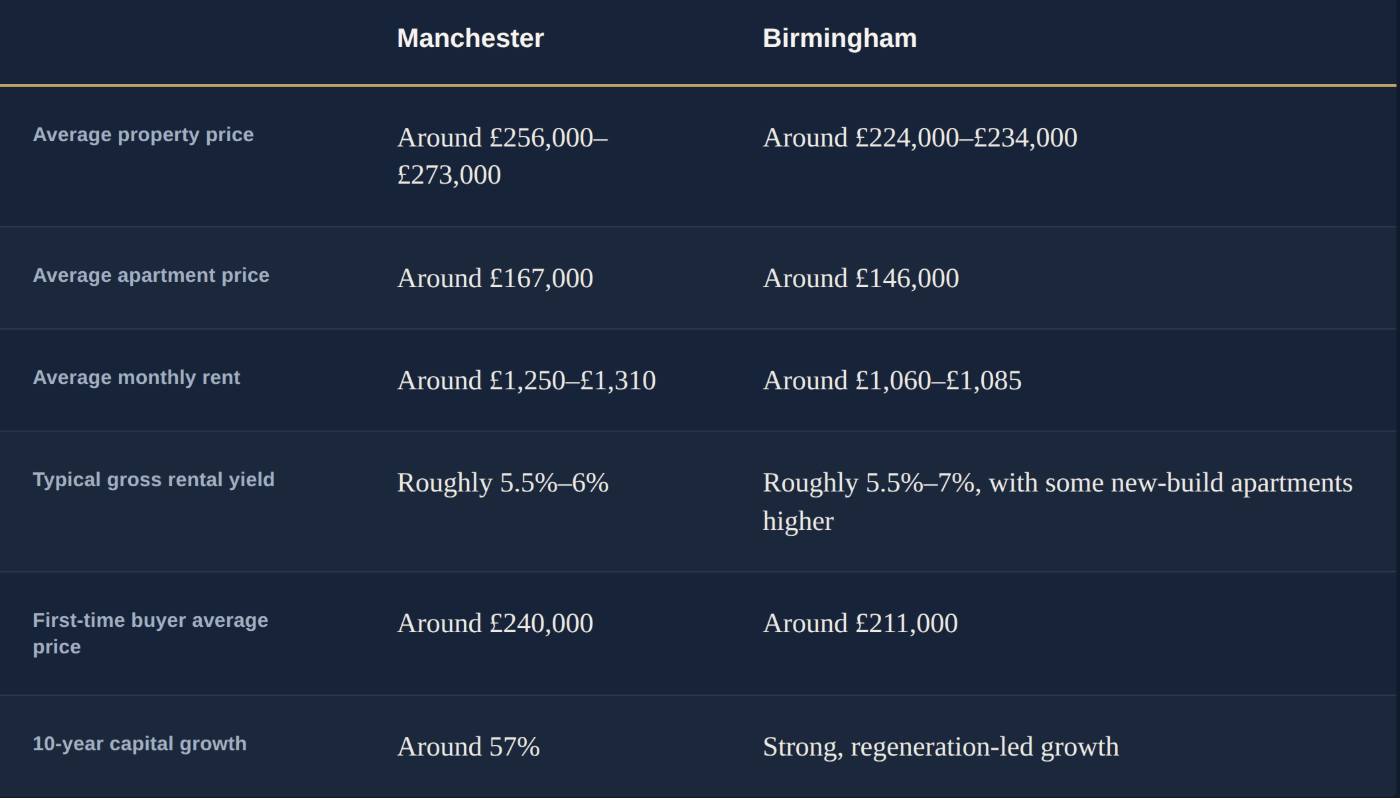
Figures are approximate, based on current market reporting for 2025/2026, and will vary by postcode and property type. Always verify live pricing with your investment consultant before committing.
The short version: Birmingham is the cheaper way in, Manchester is the more established market. Neither number tells the whole story on its own, so let's unpack and breakdown the "why" in detail.
Manchester: The Mature Powerhouse
Manchester's transformation from industrial city to Europe's fastest-growing tech and media hub is well documented, and the numbers back it up from ground up.
- Population growth across Greater Manchester is projected to keep climbing, which continues to underpin rental demand in the city centre and inner suburbs.
- The £2.5 billion Bee Network is bringing buses, trams, cycling routes and, eventually, local rail under one integrated system, improving accessibility to jobs across the wider region. You can track its rollout on the official Transport for Greater Manchester site.
- A deep, liquid rental market driven by graduates, young professionals and a growing tech and media sector around MediaCityUK means voids tend to be short, even if yields have compressed slightly as the city has become better known to investors.
The trade-off is the price. Manchester has been a favourite destination for UK and overseas investors for over a decade, and that popularity shows up in the price tag. Competition for well-located units in areas like Ancoats, Salford Quays and the city centre can be fierce, which can squeeze entry-level yields even as rents keep rising.
Birmingham: The Regeneration Story
If Manchester is the city that has already arrived, Birmingham is the city mid-transformation, and that's exactly what makes it interesting to investors right now.
- HS2's Curzon Street terminus sits at the heart of the Big City Plan, one of the largest city centre regeneration schemes in Europe. Even amid well-publicised delays and cost debates around the wider HS2 project, the Curzon Street development itself continues to reshape the surrounding district. You can read the latest on the official HS2 website.
- A lower entry price, typically £30,000–£50,000 below Manchester, means more of an investor's budget goes into the asset rather than the deposit, which can support stronger cash-on-cash returns.
- A young, growing population, with more than 80,000 students across its universities and strong graduate retention, keeps rental demand broad-based across both purpose-built student accommodation and city centre apartments.
- Faster recent rental growth, with several market reports pointing to Birmingham rents rising faster than Manchester's over the past few years as demand has caught up with the city's regeneration pipeline.
The trade-off here is maturity. Birmingham's investment story is more recent, which means less long-term data to lean on and a market that is still proving itself compared with Manchester's multi-decade track record.
So, Which City Should You Choose?
There's no universally "right" answer to this question, but there is a right answer depending on your strategy:
Choose Manchester if you want:
- A well established market with a long track record of capital growth
- Deep, resilient tenant demand across multiple sectors (tech, media, finance, students)
- A city where infrastructure investment (the Bee Network) is already being delivered
Choose Birmingham if you want:
- A lower entry price with strong headline yields
- Exposure to a regeneration story that is still playing out, with HS2's Curzon Street at its centre
- Faster recent rental growth off a lower price base
Many experienced investors don't pick one over the other. They build exposure to both, treating Manchester as the steadier, income-focused holding and Birmingham as the higher-growth, regeneration-led play.
Frequently Asked Questions
Is Manchester or Birmingham better for rental yield?
The two cities are broadly comparable on paper, typically in the 5.5%–7% range depending on the source, property type and postcode. Birmingham's lower entry prices mean some new-build apartments post higher headline yields, while Manchester's yields tend to be more consistent across a mature, high-demand market.
Which city has better long-term capital growth potential?
Manchester has the longer track record, with roughly 57% growth over the past decade. Birmingham's growth story is more recent and tied closely to the completion of major regeneration projects like Curzon Street, so its long-term trajectory carries more upside but also more uncertainty.
Is Birmingham cheaper to invest in than Manchester?
Yes, on an average. Birmingham's average property price sits roughly £30,000–£50,000 below Manchester's, and the gap is similar for city centre apartments, which typically makes Birmingham the lower-capital entry point.
Does HS2 still make Birmingham a good investment case?
The wider HS2 timeline has changed since the project was first announced, and investors should add that into their expectations. However, the Curzon Street terminus and the surrounding Big City Plan regeneration are proceeding independently of the national rail debate, and continues to drive development and demand in that part of the city.
Should I invest in Manchester or Birmingham as a first-time property investor?
It depends on your budget and risk appetite. A lower entry price in Birmingham can make it more accessible for a first purchase, while Manchester's longer track record may suit investors who prioritise a proven market over a lower ticket price. Speaking with a property investment consultant about your specific goals is the best way to decide.
Get Tailored Advice for Your Portfolio
Manchester and Birmingham both have a place in a well-built UK property portfolio, but the right choice depends on your budget, timeline and appetite for risk. At Redmayne Smith Marketing LLC, we help investors compare opportunities across the UK's top-performing cities and match them to the right strategy.
Prefer to talk it through first? Book a call with one of our team and we'll help you work out whether Manchester, Birmingham, or a blend of both fits your goals.
Click here to view our current investment opportunities to discover how you can generate the maximum return on your investment.

Leave A Reply
Your email address will not be published, Required fields are marked *